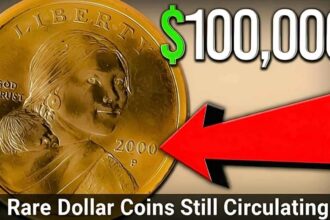

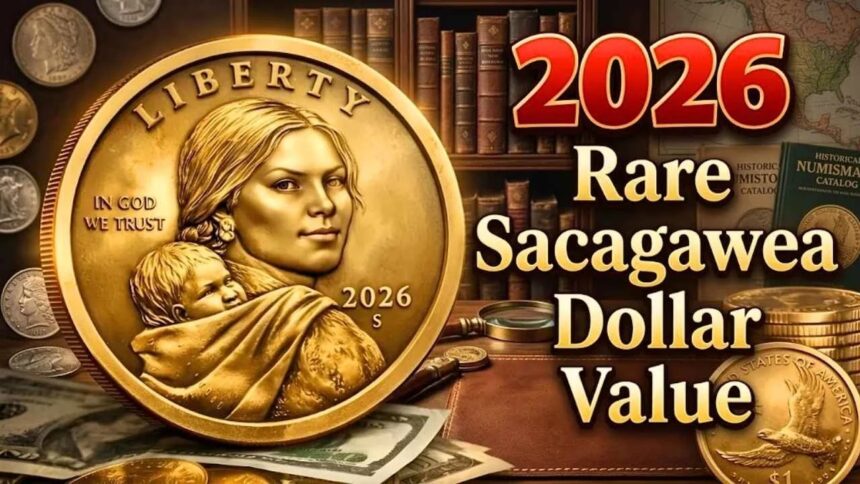
The Sacagawea Dollar has become one of the most fascinating modern U.S. coins among collectors in 2026. Although many people still treat these golden-colored coins as ordinary pocket change, certain rare varieties and mint errors are worth far more than their one-dollar face value. Some rare examples have sold for thousands of dollars, while a few elite specimens continue drawing intense attention at major auctions.
- The Beginning of the Sacagawea Dollar Series
- Understanding Sacagawea Dollar Mint Marks
- The Famous 2000-P Mule Error
- Cheerios Dollar Variety
- Wounded Eagle Error Explained
- Edge Lettering and Missing Edge Errors
- Why Condition Matters in Sacagawea Dollar Values
- How to Identify Valuable Sacagawea Dollars
- Why Sacagawea Dollars Remain Popular in 2026
- Final Thoughts
What makes the Sacagawea Dollar especially interesting is that valuable coins can still appear in circulation, bank rolls, and forgotten collections. Many collectors enjoy the thrill of searching for unusual mint marks, rare design varieties, and dramatic minting mistakes hidden among common coins.
Understanding the history, error varieties, and mint mark differences within the Sacagawea Dollar series can help collectors identify coins with significant value potential.
The Beginning of the Sacagawea Dollar Series
The U.S. Mint introduced the Sacagawea Dollar in 2000 as a replacement for the Susan B. Anthony Dollar. The goal was to create a more visually distinctive dollar coin that would circulate more successfully in everyday commerce.
The coin features Sacagawea carrying her infant son Jean Baptiste on the obverse side. The original reverse design displayed a soaring eagle, while later Native American Dollar issues introduced changing reverse designs each year.
Unlike traditional silver-colored coins, the Sacagawea Dollar has a golden appearance created by a manganese-brass alloy layer. Despite its color, the coin contains no actual gold.
Although the series never fully replaced paper dollar bills, collectors quickly became interested in rare varieties and unusual mint errors.
Understanding Sacagawea Dollar Mint Marks
Mint marks are one of the first things collectors examine when evaluating Sacagawea Dollars.
Coins struck at the Philadelphia Mint carry a “P” mint mark, while Denver Mint coins feature a “D.” Proof versions produced for collectors at the San Francisco Mint display an “S” mint mark.
The mint mark appears near the date on the front side of the coin. Although many common-date coins remain affordable, certain mint locations become much more valuable when paired with rare varieties or high-grade preservation.
Collectors often compare Philadelphia and Denver issues carefully because subtle differences in strike quality and rarity can impact market value.
Proof coins from San Francisco are especially desirable because they feature mirror-like surfaces and sharper details than regular circulation strikes.
The Famous 2000-P Mule Error
The most legendary Sacagawea Dollar error is undoubtedly the famous 2000-P mule error.
This remarkable coin was accidentally struck using the obverse die of a Washington quarter paired with the reverse die of a Sacagawea Dollar. The result created a coin showing George Washington on the front instead of Sacagawea.
Only a tiny number of these errors are known to exist, making them among the rarest and most valuable modern U.S. coins.
Collectors immediately recognized the importance of this minting mistake because mule errors involving two completely different coin designs are extremely rare.
Some examples have sold for well over $100,000, and demand remains strong among elite collectors in 2026.
If a golden Sacagawea Dollar displays Washington’s portrait, it should be professionally authenticated immediately.
Cheerios Dollar Variety
One of the most intriguing Sacagawea Dollar varieties originated from a cereal promotion.
In 2000, the U.S. Mint partnered with Cheerios to distribute Sacagawea Dollars inside cereal boxes as part of a national advertising campaign. For years, collectors believed these coins were identical to standard issues.
Later, experts discovered that some promotional coins displayed enhanced eagle tail feathers on the reverse side. The additional detail separated these “Cheerios Dollars” from ordinary circulation coins.
The design difference may appear subtle, but collectors consider this one of the most important modern coin varieties.
High-grade Cheerios Dollars continue bringing strong prices because of their rarity and historical significance.
Wounded Eagle Error Explained
The “Wounded Eagle” error remains one of the most famous Sacagawea Dollar die varieties.
This error appears as a raised line crossing the eagle’s body on the reverse side, giving the impression that the bird has been pierced or scratched.
The unusual marking resulted from die gouges during production. Because multiple coins were struck from the damaged die, collectors eventually recognized the error as a legitimate variety.
The dramatic appearance of the line makes the Wounded Eagle easy to identify compared to many subtle coin errors.
Collectors continue searching for these coins because attractive examples often command impressive premiums.
Edge Lettering and Missing Edge Errors
Later Native American Dollar issues introduced edge lettering featuring dates, mint marks, and mottos around the coin’s edge.
This production method created opportunities for several interesting mint errors. Some coins were struck without edge lettering entirely, while others display doubled or partially missing inscriptions.
Missing edge lettering errors became especially popular because the mistake is immediately noticeable.
Collectors often inspect the edges of dollar coins carefully because unusual edge varieties can become surprisingly valuable.
Coins with complete missing inscriptions or dramatic doubling continue attracting collector attention in 2026.
Why Condition Matters in Sacagawea Dollar Values
Condition plays a major role in determining the value of Sacagawea Dollars.
Many coins were stored loosely in bags or rolls, causing scratches and contact marks that reduce collector appeal. Perfectly preserved coins are much scarcer than many people realize.
Professional grading companies evaluate coins based on luster, strike quality, surface preservation, and overall eye appeal.
Coins receiving elite Mint State grades often become dramatically more valuable than average examples. A single grade difference can sometimes increase a coin’s value by thousands of dollars.
Proof coins are also highly collectible because of their polished surfaces and sharp details.
Collectors seeking investment-quality coins often focus on certified high-grade examples.
How to Identify Valuable Sacagawea Dollars
Collectors searching for valuable Sacagawea Dollars should begin by checking the mint mark, date, and overall condition.
Use magnification to inspect details such as eagle tail feathers, die cracks, doubled lettering, or unusual raised lines.
Pay close attention to edge lettering on later issues because missing or doubled inscriptions may indicate valuable errors.
Coins with strong luster, minimal scratches, and sharp details usually carry stronger collector demand.
Avoid cleaning coins because polishing can permanently damage surfaces and reduce value.
If a coin appears especially unusual, professional authentication is recommended before selling or purchasing.
Why Sacagawea Dollars Remain Popular in 2026
Sacagawea Dollars continue attracting collectors because they combine modern history with the excitement of error hunting.
Unlike many older rare coins that are expensive to acquire, Sacagawea Dollars remain accessible to beginners while still offering the possibility of valuable discoveries.
The series also honors Native American history and represents an important period in modern U.S. coin design.
Social media, online auctions, and collector communities have helped increase awareness of rare Sacagawea Dollar varieties in recent years.
Collectors enjoy the idea that hidden treasures may still exist inside ordinary coin rolls or forgotten collections.
Final Thoughts
The Sacagawea Dollar series remains one of the most exciting areas of modern American coin collecting in 2026. Rare mint errors, unique varieties, and collectible mint marks continue driving strong interest among hobbyists and investors alike.
From the legendary 2000-P mule error to Cheerios Dollars and Wounded Eagle varieties, these coins prove that modern currency can still hold extraordinary value. For collectors, every Sacagawea Dollar represents a chance to uncover a rare piece of minting history hiding in plain sight.